
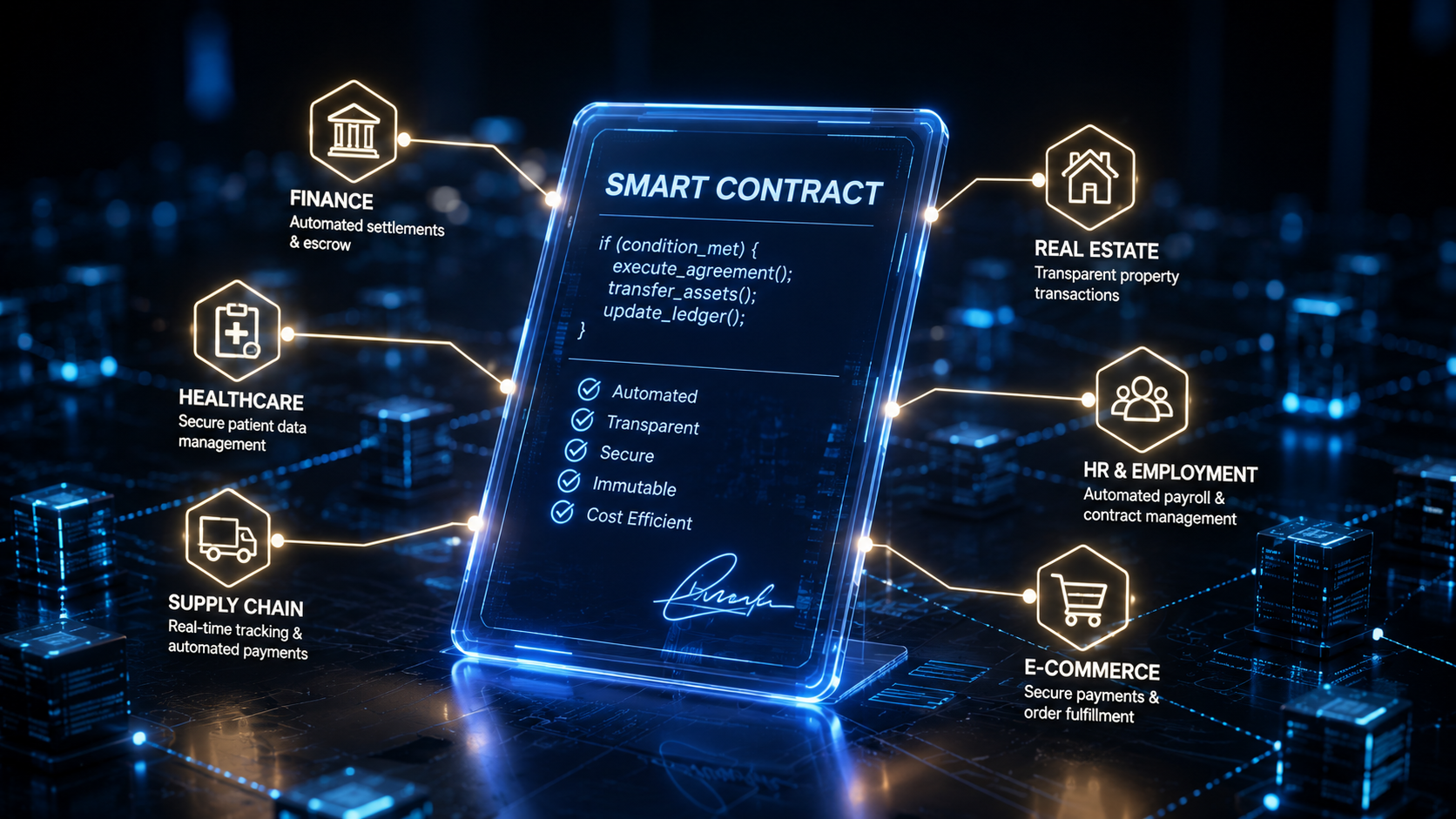

Discover how Smart Contracts automate agreements, improve transparency, reduce costs, and transform business operations across multiple industries.
Smart Contracts: Benefits and Business Applications
Blockchain technology has introduced new ways for businesses to automate transactions and improve operational efficiency. Among its most significant innovations are Smart Contracts, which automatically execute agreements when predefined conditions are met. By eliminating many manual processes, smart contracts increase transparency, reduce administrative costs, and improve trust between parties.
As blockchain adoption continues to grow, businesses across numerous industries are exploring smart contracts to streamline operations and create more secure digital workflows.
What Are Smart Contracts?
Smart Contracts are self-executing digital agreements stored on a blockchain. They automatically perform predefined actions once specific conditions are satisfied without requiring manual intervention.
Because they operate on blockchain networks, their execution is transparent, secure, and resistant to unauthorized changes.
How Smart Contracts Work
Smart contracts contain programmed rules that define how an agreement should be executed. Once all required conditions are fulfilled, the contract automatically carries out the agreed action, such as transferring funds, granting access, or updating ownership records.
Automation minimizes delays while reducing reliance on intermediaries.
Improve Business Efficiency
Manual contract management often requires paperwork, approvals, and multiple verification steps. Smart contracts automate many of these processes, allowing transactions to be completed more quickly and accurately.
Improved efficiency enables businesses to reduce processing time and operational costs.
Increase Transparency
Every transaction executed through Smart Contracts is permanently recorded on the blockchain. Authorized participants can verify contract activity while maintaining confidence that records cannot be altered without consensus.
Greater transparency strengthens trust between business partners.
Reduce Operational Costs
By automating contract execution, businesses reduce administrative expenses, paperwork, legal processing, and third-party service fees.
Lower operational costs improve profitability while simplifying business workflows.
Strengthen Security
Blockchain technology uses advanced cryptographic methods to secure transaction data. Once deployed, smart contracts are difficult to modify without proper authorization, reducing the risk of fraud or unauthorized alterations.
Strong security helps protect valuable business information.
Supply Chain Management
Businesses use smart contracts to automate inventory tracking, shipment verification, payment releases, and supplier agreements. Automated processes improve visibility while reducing delays throughout the supply chain.
Supply chain automation improves operational reliability.
Financial Services
Banks and financial institutions increasingly explore smart contracts for payment processing, lending, insurance claims, trade finance, and digital asset management.
Automation improves transaction speed while reducing administrative complexity.
Real Estate Transactions
Smart contracts simplify property transfers by automatically executing agreements once payment verification, legal documentation, and ownership requirements are completed.
Digital transactions reduce paperwork and improve transaction efficiency.
Healthcare Applications
Healthcare providers can use smart contracts to securely manage patient consent, medical records, insurance claims, and healthcare payments while maintaining strict data security standards.
Automation improves administrative efficiency across healthcare systems.
Future Business Opportunities
As blockchain technology matures, Smart Contracts are expected to support more advanced business applications across manufacturing, logistics, government services, intellectual property management, and decentralized finance.
Growing adoption continues to expand opportunities for digital transformation.
Conclusion
Smart Contracts are transforming how businesses execute agreements by automating transactions, improving transparency, strengthening security, and reducing operational costs. From finance and supply chain management to healthcare and real estate, organizations are discovering new ways to leverage blockchain technology for greater efficiency. As digital transformation accelerates, smart contracts will continue to play an increasingly important role in modern business operations.
FAQ
1. What are Smart Contracts?
Smart Contracts are self-executing digital agreements stored on a blockchain that automatically perform predefined actions when specified conditions are met.
2. What are the benefits of Smart Contracts?
They improve efficiency, reduce costs, enhance transparency, strengthen security, minimize human error, and eliminate many manual administrative processes.
3. Which industries use Smart Contracts?
Industries including finance, real estate, healthcare, supply chain management, insurance, manufacturing, and logistics are adopting smart contract technology.
4. Are Smart Contracts secure?
Yes. Smart contracts operate on blockchain networks that use advanced cryptographic security and immutable transaction records, making unauthorized modifications extremely difficult.
5. Why are Smart Contracts important for businesses?
Smart Contracts help businesses automate agreements, reduce processing time, improve operational efficiency, strengthen trust, and support digital transformation across various industries.
